
VAPT vs Continuous SOC Monitoring: Dubai Defense Guide

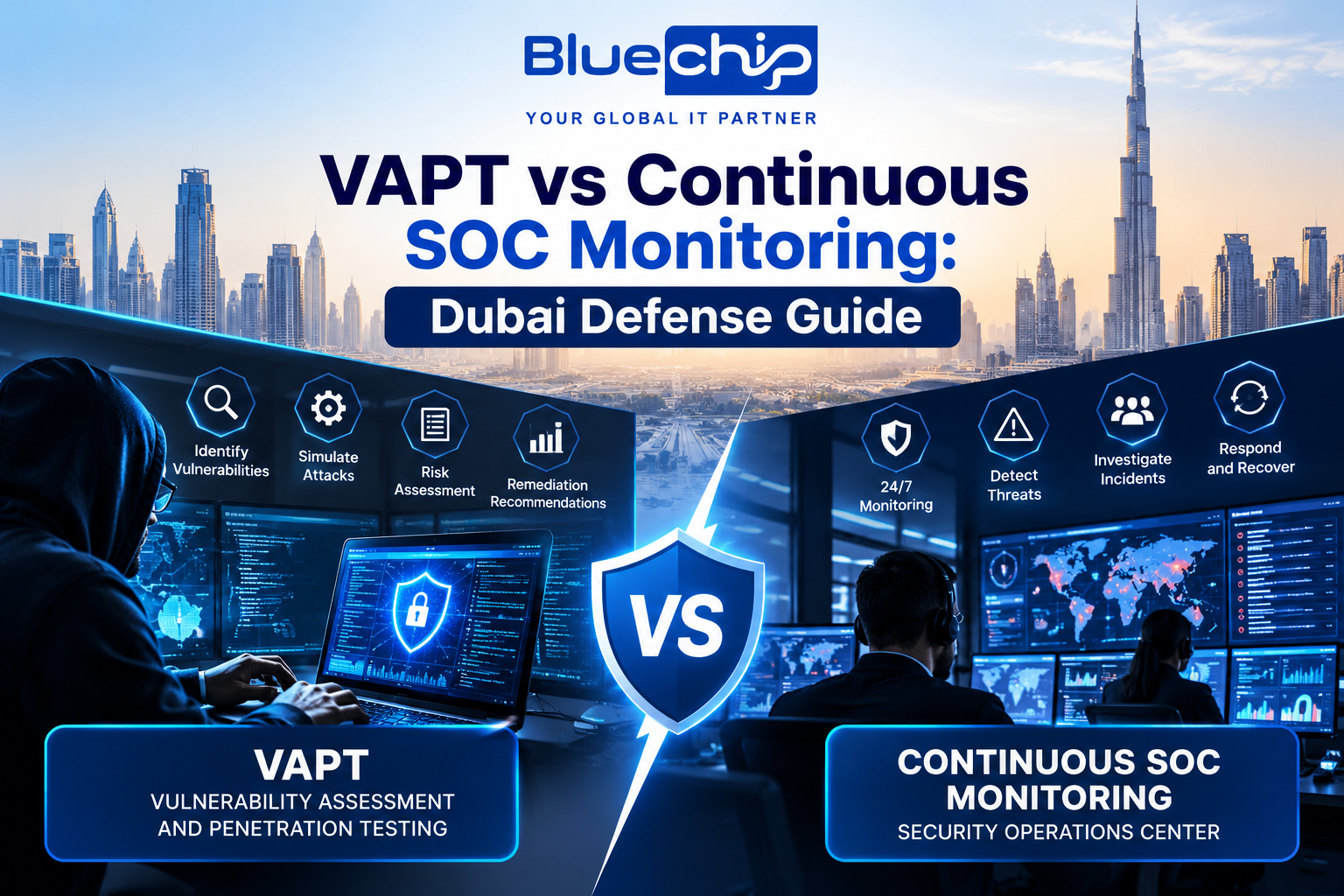
Would you know if your business had a security weakness before an attacker exploited it – or recognise an attack before it had an impact? For organisations based in Dubai, these are two different cybersecurity challenges. Vulnerability Assessment and Penetration Testing (VAPT) helps businesses identify and validate weaknesses, while a Security Operations Centre (SOC) focuses on identifying suspicious activity and supporting incident response. Both approaches improve organisational cybersecurity, but have different objectives.
Understanding the difference can help businesses select the appropriate combination of controls, and manage risks to protect critical business information. Here is how VAPT and continuous SOC monitoring compare, and what organisations can consider in 2026.
What Is VAPT and Why Does It Matter?
Vulnerability Assessment and Penetration Testing involves identifying weaknesses and, where appropriate and authorised, testing whether those weaknesses can be exploited.
A vulnerability assessment typically identifies potential issues across systems, applications and configurations, while penetration testing works in a controlled manner to exploit selected weaknesses within an agreed scope.
Working with an experienced penetration testing company in the UAE can help organisations understand their exposure and prioritise corrective action.
Key Benefits of VAPT
- Identifies security weaknesses: Highlights vulnerabilities in applications, networks and infrastructure.
- Validates potential attack paths: Authorised testing helps determine whether selected could be exploited.
- Supports remediation planning: Findings can be prioritised according to severity and business impact.
- Helps evaluate security controls: Testing can reveal gaps that routine configuration reviews may overlook.
- Supports security assurance: Assessment reports can be useful for internal risk management and relevant compliance activities.
VAPT can be particularly important when launching a new application, or following major infrastructure, security, or other changes, as part of a regular schedule, or when investigating a large change in an organisation’s risk profile.
A successful test does not guarantee that a system will remain secure following new vulnerabilities, configuration changes or emerging threats.
What Is Continuous SOC Monitoring?
A Security Operations Centre monitors security events across an organisation’s IT environment to detect suspicious activity, investigate potential incidents, and coordinate an appropriate response.
Depending on the scope of service provision, SOC operations can include log and alert monitoring, threat detection, incident triage and escalation. Continuous monitoring makes it possible to detect activity that would not necessarily be identified by a scheduled security assessment.
For businesses looking for SOC services in Dubai, the objective is to improve visibility into security events and reduce the time spent detecting and investigating an incident.
Key Benefits of SOC Monitoring
- Ongoing security visibility: Monitors relevant events from connected systems and security tools.
- Earlier threat detection: Helps identify suspicious behaviour such as unusual logins or potential malware activity.
- Incident investigation: Supports analysis of alerts to determine whether they indicate a genuine threat.
- Response coordination: Helps security teams follow appropriate escalation and incident-handling procedures.
- Improved security awareness: Event records and incident trends can help organisations spot recurring weaknesses.
The actual level of coverage will depend on the monitoring arrangement, including hours of monitoring, connected data sources, response responsibilities, and service-level agreements. Businesses should clarify that a provider offers genuine 24/7 monitoring and what it can do if an incident occurs.
VAPT vs. SOC Monitoring: Key Differences
| Comparison | VAPT | Continuous SOC Monitoring |
| Primary purpose | Find and validate security weaknesses | Detect and investigate suspicious activity |
| Operating approach | Scheduled assessments and authorised tests | Ongoing monitoring according to the service scope |
| Main focus | Vulnerabilities and potential attack paths | Security events, alerts and possible incidents |
| Typical output | Findings, risk ratings and remediation recommendations | Alerts, investigations, incident escalation and reporting |
| Best for | Understanding and reducing security weaknesses | Improving threat visibility and incident detection |
The right choice depends on a business’s current security maturity, infrastructure, risks and available resources.
Choose VAPT When You Need To Identify Weaknesses
VAPT can be a priority if a business is launching a new digital platform or operating internet-facing applications, or upgrading its network. It can help identify weaknesses that should be addressed to reduce the risk of exploitation.
Organisations should also consider follow-up assessments where appropriate to validate findings.
Choose SOC Monitoring When You Need Ongoing Threat Visibility
SOC monitoring can be especially valuable when a business relies on critical applications and cloud services, remote access or systems that produce security events throughout the day.
It can support teams investigating suspicious activity rather than waiting for the next scheduled VAPT assessment. Businesses should ensure that the service is tailored to the relevant systems and includes appropriate escalation and response protocols.
Combine Both for a Stronger Security Strategy
For many businesses, using VAPT and SOC monitoring together is a sound way to improve threat management.
VAPT can identify weaknesses in need of remediation, and SOC monitoring can help detect suspicious activity across the environment. Assessment findings can guide monitoring activities, helping security teams focus on important assets and potential attack paths.
This combination can support a more comprehensive approach to cybersecurity, complemented by timely patching, secure configurations, access control measures, employee awareness and incident response protocols.
The Role of SIEM Solutions in Enterprise Security
SIEM technology collects and analyses security logs and events from connected sources, helping security teams identify patterns that might indicate a threat.
In Dubai, a SIEM solution could support SOC monitoring by enabling analysts to investigate alerts and understand activity across the IT environment.
SIEM technology is not a comprehensive security strategy, and its value depends on the quality of the data collected and the detection rules, alert tuning, analyst expertise and response procedures in place.
Businesses should consider the data sources that need to be connected, alert handling and response, and whether the proposed solution meets their requirements.
Strengthen Your Cybersecurity Strategy with Bluechip Gulf
Choosing between VAPT and continuous SOC monitoring should begin with an understanding of an organisation’s risks. Businesses should consider their critical assets, security controls, incident response capabilities and weaknesses that need to be addressed.
Bluechip Computer Systems LLC offers IT and cybersecurity services to businesses. Organisations interested in strengthening their security can discuss their requirements and determine which assessment, monitoring or other measures are appropriate.
Before engaging a provider, businesses should clarify the precise service offer, assessment approach, monitoring coverage, response responsibilities, and reporting arrangements.
Protect Your Business Before Threats Become Costly Incidents
VAPT and SOC monitoring address different types of cybersecurity challenges. VAPT helps organisations uncover and validate weaknesses, while SOC monitoring supports ongoing detection and investigation of suspicious activity. For many businesses, combining both is a good way to improve threat management.
Not sure what security approach is right for your business?
Contact Bluechip Gulf to discuss your cybersecurity requirements and explore the options for vulnerability assessment, penetration testing, security monitoring and protection of critical business systems.